

Saturday, June 03, 2006


Friday, June 02, 2006


Monday, May 29, 2006


Tuesday, May 09, 2006
The Spiritual Awakening of John Coltrane
ALL PRAISE BE TO GOD WHOM ALL PRAISE IS DUE.
Let us pursue Him in the righteous path. Yes it is true: "seek and ye shall find." Only through Him can we know the most wondrous bequeathal.
During the year 1957, I experienced, by the grace of God, a spiritual awakening which was to lead me to a richer, fuller, more productive life. At that time, in gratitude, I humbly asked to be given the means and privilege to make others happy through music. I feel this has been granted through His grace. ALL PRAISE TO GOD.
As time and events moved on; a period of irresolution did prevail. I entered into a phase which was contradictory for the pledge and away from the esteemed path; but thankfully now and again through the unerring and merciful hand of God, I do perceive and have been duly re-informed of His OMNIPOTENCE, and of our need for, and dependence on Him. At this time I would like to tell you that NO MATTER WHAT...IT IS WITH GOD. HE IS GRACIOUS AND MERCIFUL. HIS WAY IS IN LOVE, THROUGH WHICH WE ALL ARE. IT IS TRULY-A LOVE SUPREME-.
This album is a humble offering to Him. An attempt to say "THANK YOU GOD" through our work, even as we do in our hearts and with our tongues. May He help and strengthen all men in every good endeavor.
The music herein is presented in four parts. The first entitled "Acknowledgment", the second, "Resolution", the third, "Pursuance", and the fourth and last part is a musical narration of the theme,
"A Love Supreme" which is written in the context: it is entitled "Psalm".
Our appreciation and thanks to all people of good will and good works the world over, for in the bank of life is not good that investment which surely pays the highest and most cherished dividends?
May we never forget that in the sunshine of our lives, through the storm and after the rain-it is all with God-in all ways and forever.
ALL PRAISE TO GOD.
With love to all, I thank you.
John Coltrane- December 1964
A LOVE SUPREME
I will do all I can to be worthy of Thee O Lord.
It all has to do with it. Thank you God.
Peace. There is none other. God is. It is so beautiful.
Thank you God. God is all.
Help us to resolve our fears and weaknesses.
Thank you God. In You all things are possible.
We know. God made us so. Keep your eye on God.
God is. He always was. He always will be.
No matter what...it is God. He is gracious and merciful.
It is most important that I know Thee.
Words, sounds, speech, men, memory, thoughts, fears and emotions-time-all related...all made from one...all made in one. Blessed be His name.
Thought waves-beat waves-all vibrations-
all paths lead to God. Thank you God.
His way...it is so lovely...it is gracious.
It is merciful-Thank you God.
One thought can produce millions of vibrations and
they all go back to God...everything does.
Thank you God. Have no fear...believe...
Thank you God. The universe has many wonders.
God is all. his way...it is so wonderful.
Thoughts-deeds-vibrations, etc.
They all go back to God and He cleanses all.
He is gracious and merciful...Thank you God.
Glory to God...God is so alive. God is. God loves.
May I be acceptable in Thy sight.
We are all one in His grace. The fact that we do exist is acknowledgment of Thee O Lord. Thank you God.
God will wash away all our tears...He always has...
He always will. Seek Him everyday.
In all ways seek God every day.
Let us sing all songs to God
To whom all praise is due...praise God.
No road is any easy one, but they all go back to God.
With all we share God. It is all with God
It is all with Thee. Obey the Lord. Blessed is He.
We are all from one thing...the will of God
Thank you God.
I have seen God-I have seen ungodly-
none can be greater-none can compare to God.
Thank you God.
He will remake us...He always has and He always will.
It is true-blessed be His name-Thank you God.
God breathes through us so completely...so gently we hardly
feel it...yet, it is our everything. Thank you God. ELATION-ELEGANCE- EXALTATION-
All from God. Thank you God. Amen.
Tuesday, May 02, 2006
trance-formation
In religion and politics, people's beliefs and convictions are in almost every case gotten at second hand, and without examination.
- Mark Twain
- Mark Twain
Monday, May 01, 2006
Fear is the mind killer
I must not fear.
Fear is the mind killer.
Fear is the little death that brings total obliteration.
I will face my fear.
I will permit it to pass over me and through me.
And when it has gone past, I will turn the inner eye to see its path.
When the fear has gone there will be nothing.
Only I will remain.
Frank Herbert in "Dune"
Friday, April 28, 2006
We're only spying on Americans to PROTECT them...
Patriotism is the last refuge of a scoundrel.
- Samuel Johnson
- Samuel Johnson
Friday, April 21, 2006
Undefeated
"When I despair, I remember that all through history the way of truth and love has always won. There have been tyrants and murderers and for a time they seem invincible, but in the end, they always fall - think of it, always."
--Mahatma Gandhi
--Mahatma Gandhi
Thursday, April 20, 2006
http://www.waynemadsenreport.com/
April 20, 2006 -- Beating Bush's NSA e-mail surveillance simple. According to NSA sources, there is a simple method to avoid having one's e-mail captured by NSA Internet filters that have been installed within major Internet exchanges, such as the AT&T facility in San Francisco, which is the subject of a class action suit against AT&T. By typing "Viagra" or "Cialis" in the message text, the filters will automatically identify the e-mail as spam and ignore it. The e-mail could contain the words "Al Qaeda" or "Bin Laden," but as long as Viagra or Cialis are also contained in the text, the e-mail will pass through the filters without being intercepted.

Beating NSA e-mail surveillance -- use the "blue pill" and your e-mail will not go down the rabbit hole.

Beating NSA e-mail surveillance -- use the "blue pill" and your e-mail will not go down the rabbit hole.
good advice
If you don't like the answers you seem to be getting, try asking different questions.
If you don't like the conversations you are holding, try talking to other people.
If you are not pleased with the hand you have been dealt, see if you can swap it or negotiate for some other set of opportunities and challenges.
No matter what obstacles are in your path now, there is also fluidity and flexibility.
Nothing has to be the way that it has been in the past, unless you want to preserve it.
Wednesday, April 19, 2006
Dow/Gold ratio implies we are only halfway through bull cycle

The first two bold blue lines highlight the 14-year periods when gold outperformed the DJIA (1928-1942 and 1965–1979). The current third bold line shows that gold has been outperforming the DJIA since 1999 – implying we are half way through this cycle.

Tuesday, April 11, 2006

Monday, April 10, 2006
Saturday, April 08, 2006
edan "promised land"
out the dungeon of brain pain, I came, with a sell-a-lot plot from the
megawatt mainframe-
with a suit made of electricity, I ran through the Great Wall of China,
convincingly-
that was after the world tour, when I travelled through gravel and battled
matter at the earth's core-
I did the show on a fireball, a pioneer, ran into the jungle and jetted
wearing a lion's ear-
I fought fear with the hammer Thor lent me, and tangled with the Angel of
Death for four centuries-
put a name-plate on the asteroid belt and I ran through the future with an
android's help-
that's when civilians were made of metal. I received a coronation 'cause I
had the last flower petals-
my power settled a clash between races and put good people on the magazine
faces-
substituted television scandals with elephants and pandas, tell 'em its the
elegant commando-
with a hand so big, I punched the Sphinx in the nose, and the nose
decomposed, and so the story goes...
I slapped a 40 o(z) out of a young man's hand and fed him lessons of life to
formulate a plan-
I wore the prime meridian as a wristband, and gave a my riches, but I still
remained a rich man-
the quicksand I witstood, for good, as I hopped a dragonfly to outer space
and met Count Bass....
Thursday, April 06, 2006
Gold hits $600/oz.
“You can observe a lot by watching. We made too many wrong mistakes.”-Yogi Berra
The following points are my opinions and I stand ready to argue about them all day. You may disagree with me, but try to keep an open mind and carefully review this market fundamentals list. Also, think about the implications of these market viewpoints.
By Roger Wiegand
March 30, 2006
(1) Government news and policy is either wrong, damaging or both. Smart traders most always go opposite the news. M-3 measurement of cash is now unpublished. Why is this? We think to simply hide the scary numbers. 2. Oil is not plentiful and prices are going higher. Supply is not going down. Usage is going up. (3) Iraq was all about oil. Iran and Syria are next on the oil hit list. Syria is a walk-over, but Iran is formidable. (4) The US Dollar is going down in the long term, up in the short term. (5) Interest rates are mildly up in the short term and then are flat to down. (6) We have both inflation and deflation right now. Confusion reigns as observers do not know which one has the power. Answer-They both do for today. Either we get an inflationary blow-off followed by deflation or we get deflation. The end game is depression. Is the world ending? No it is not. It’s just getting a bit nasty for a few years until this big mess goes through its historical cycle then life goes on.
(7) Swiss Francs and Canadian Dollars are going up. The Euro is going up then down, and then disappears. (8) Gold and silver are going up. (9) Inflationary daily life will become much tougher. (10) All government from the lowest to the highest will not belt tighten like us little folks. They will grab for more and take more. (11) If the grabbing becomes too pushy, consumers will push back. (12) Crime will sky rocket as will unemployment. (13) Cash becomes king while debt a millstone on your neck. Then, gold and silver will become the king of kings. 14) Paper of all kinds, notes, mortgages, loans, etc. become worthless or worth less. (15) Today’s events are like the 1930’s. The Nasdaq implosion was identical to 1929. Today, we are preparing for the next wave of selling after a bear market bounce. We will get at least two more head fake bear market rallies in the race to the bottom for mainstream stocks. Next will resemble 1937 in market action which was negative.
(16) Professional stock market people are dumping securities with both hands into each buying rally. (17) The Sheeple are encouraged to buy the dips so the pros can use the rallies to sell out. (18) Overpaid CEO’s are selling stock with both hands and running with the money. Many then retire for “family and personal reasons.” (19) Even small accounts can make big winnings if you are on the right side of the trade. (20) Loose lips sink ships. Don’t sink your ship. Act poor and live comfortably.
(21) GM has lost over $10 billion for 2005. Their cash flow is a negative $3 billion and they lost $8 billion net excluding accounting problems. Their annual healthcare expenditure equaled the net loss of $8 billion. WSJ reports they must downsize and close four plants. Now they say 12 plants. They offered buyouts to retire 35,000 employees. They need to shed 45-85,000 jobs and 25 plants but the unions will not permit it. They will be headed to bankruptcy court in late 2006 or 2007 when union contract talks enter stalemate. Annual healthcare costs are $10,000 per current or retired employee. All corporations will be seeking to escape health care expenses partially or entirely. Look for repudiated pensions and healthcare liabilities to be dumped on the federal government. The government’s pension bail-out fund is now broke. They will just print more cash to cover accelerating costs.
(22) The March PPI rose 0.7% in 2005 the highest in four months. Energy costs are the main driver. Oil is holding in the $64.50-66.50 range as we forecast. Unleaded fuel this summer or early fall will be +$3.00 at the pump due to refinery shortages as we reported. Within 18 months gas will be $5 a gallon. Oil is going to $85 a barrel within 12 months or less. Attacks on Syria and Iran could cause it to rise sooner. We expect the violence to begin sometime in 2006 to prevent Iran from using an atomic bomb on New York City. Iran has a big military that could be severely damaged. Israel and the US Stryker Forces are on maneuvers right now in southern Israel. This forecast could be obviated as news is now saying back door talks with the USA and Iran are in process and things are cooling down. (23) The support level for the Dow is 10,400-10,000 and a blow-off top is 11,400. After the 10,000 low is secured, look for 9350 next. A selling slide is imminent.
(24) Hugo Chavez is raising his oil tax on Venezuelan oil producers from 34% to 50%. After he gets away with that, then expect him to steal it all. He and Fidel are spoiling for trouble all over South America. Any foreign corporation operating in Venezuela will be a target for government theft. Indonesia has also joined this anti-business crowd. Expect other countries to follow suit as the bold become bolder in their taking-stealing efforts. (25) Middle Eastern oil rich nations are buying gold more rapidly. These same countries feel abused by the USA and are moving to trade oil in Euros and other non-USA currencies which is very big trouble. (26) Thoughtless American senators, wrangling for attention and votes are running around harassing China and other nations over currency and trade protectionist matters which ensure throwing gasoline on the USA trade deficit making life miserable for American business people.
(27) Grain is suffering from a 100 year global drought and is hitting north China particularly hard. Grain is energy powered. Everything from fertilizer, to seeds, tractors, harvesting machines and market transport will take a cheap food commodity and make it costly. World-wide supplies of grain are at 30 year lows. Supply and demand will eventually prevail. Global weather has entered one of its historically nasty cycles creating havoc for growers and insurance companies.
(28) The precious metals have a long way to rise in price. There will be ups and downs throughout the trade as there are in any market. Naysayers will try to drive you out as these rally markets can wound and perhaps kill “other status quo markets.” It’s going to be you or them. I would rather it be them and get our economy back on solid footing once more. The news is wrong and twisted to promote the status quo viewpoint. Do not ever forget this.
At its extreme, gold is on a one way track to $2,960. Modestly, the top could be $1,250. Currently, gold and silver are topping but stubbornly holding higher prices and refusing to correct. We either get a mild correction and subsequent major rally, or a larger correction followed by the same major rally. History repeats again and again. As of 3-30-06, it appears we are seeing a new gold and silver market beginning to rally.
How to Cope and be Comfortable
It will not hurt anybody to get out of debt, lower life style expectations and take steps to protect your future. If I am totally wrong what can you lose? If I am right and you stay with the status quo, what does your future look like? Don’t let the enemies of gold run you off. Hold your gold and have strength of purpose. Remember, that first of all the fundamentals mandate gold and history tells us precious metals are the place to win for several more years. –Trader Rog
Wednesday, April 05, 2006
DeLay is done
"So many minority youths had volunteered that there was literally no room for patriotic folks like myself."
- At the 1988 GOP convention, Tom DeLay (R-Scumbag) explains why he and fellow Chickenhawk Dan Quayle (R-Potatoe) did not enlist to fight in the Vietnam war, of which they both were (hypothetically) in favor.
- At the 1988 GOP convention, Tom DeLay (R-Scumbag) explains why he and fellow Chickenhawk Dan Quayle (R-Potatoe) did not enlist to fight in the Vietnam war, of which they both were (hypothetically) in favor.
Wednesday, March 29, 2006
one love
Let's get together to fight this Holy Armageddyon (One Love!)
So when the Man comes there will be no, no doom (One Song!)
Have pity on those whose chances grows t'inner
There ain't no hiding place from the Father of Creation
- Bob Marley
So when the Man comes there will be no, no doom (One Song!)
Have pity on those whose chances grows t'inner
There ain't no hiding place from the Father of Creation
- Bob Marley
Friday, March 24, 2006
50 days & counting..
"I love being married. It's so great to find that one special person you want to annoy for the rest of your life."
- Rita Rudner
- Rita Rudner
Tuesday, March 21, 2006
The Limits of Liberty
"In a strictly personalized sense, any person's ideal situation is one that allows him full freedom of action and inhibits the behavior of others so as to force adherence to his own desires. That is to say, each person seeks mastery over a world of slaves."
- James Buchanan, in his The Limits of Liberty: Between Anarchy and Leviathan.
- James Buchanan, in his The Limits of Liberty: Between Anarchy and Leviathan.
Monday, March 20, 2006
Whiny kids become conservative adults...
KURT KLEINER
SPECIAL TO THE STAR
Remember the whiny, insecure kid in nursery school, the one who always thought everyone was out to get him, and was always running to the teacher with complaints? Chances are he grew up to be a conservative.
At least, he did if he was one of 95 kids from the Berkeley area that social scientists have been tracking for the last 20 years. The confident, resilient, self-reliant kids mostly grew up to be liberals.
The study from the Journal of Research Into Personality isn't going to make the UC Berkeley professor who published it any friends on the right. Similar conclusions a few years ago from another academic saw him excoriated on right-wing blogs, and even led to a Congressional investigation into his research funding.
But the new results are worth a look. In the 1960s Jack Block and his wife and fellow professor Jeanne Block (now deceased) began tracking more than 100 nursery school kids as part of a general study of personality. The kids' personalities were rated at the time by teachers and assistants who had known them for months. There's no reason to think political bias skewed the ratings — the investigators were not looking at political orientation back then. Even if they had been, it's unlikely that 3- and 4-year-olds would have had much idea about their political leanings.
A few decades later, Block followed up with more surveys, looking again at personality, and this time at politics, too. The whiny kids tended to grow up conservative, and turned into rigid young adults who hewed closely to traditional gender roles and were uncomfortable with ambiguity.
The confident kids turned out liberal and were still hanging loose, turning into bright, non-conforming adults with wide interests. The girls were still outgoing, but the young men tended to turn a little introspective.
Block admits in his paper that liberal Berkeley is not representative of the whole country. But within his sample, he says, the results hold. He reasons that insecure kids look for the reassurance provided by tradition and authority, and find it in conservative politics. The more confident kids are eager to explore alternatives to the way things are, and find liberal politics more congenial.
In a society that values self-confidence and out-goingness, it's a mostly flattering picture for liberals. It also runs contrary to the American stereotype of wimpy liberals and strong conservatives.
Of course, if you're studying the psychology of politics, you shouldn't be surprised to get a political reaction. Similar work by John T. Jost of Stanford and colleagues in 2003 drew a political backlash. The researchers reviewed 44 years worth of studies into the psychology of conservatism, and concluded that people who are dogmatic, fearful, intolerant of ambiguity and uncertainty, and who crave order and structure are more likely to gravitate to conservatism. Critics branded it the "conservatives are crazy" study and accused the authors of a political bias.
Jost welcomed the new study, saying it lends support to his conclusions. But Jeff Greenberg, a social psychologist at the University of Arizona who was critical of Jost's study, was less impressed.
"I found it to be biased, shoddy work, poor science at best," he said of the Block study. He thinks insecure, defensive, rigid people can as easily gravitate to left-wing ideologies as right-wing ones. He suspects that in Communist China, those kinds of people would likely become fervid party members.
The results do raise some obvious questions. Are nursery school teachers in the conservative heartland cursed with classes filled with little proto-conservative whiners?
Or does an insecure little boy raised in Idaho or Alberta surrounded by conservatives turn instead to liberalism?
Or do the whiny kids grow up conservative along with the majority of their more confident peers, while only the kids with poor impulse control turn liberal?
Part of the answer is that personality is not the only factor that determines political leanings. For instance, there was a .27 correlation between being self-reliant in nursery school and being a liberal as an adult. Another way of saying it is that self-reliance predicts statistically about 7 per cent of the variance between kids who became liberal and those who became conservative. (If every self-reliant kid became a liberal and none became conservatives, it would predict 100 per cent of the variance). Seven per cent is fairly strong for social science, but it still leaves an awful lot of room for other influences, such as friends, family, education, personal experience and plain old intellect.
For conservatives whose feelings are still hurt, there is a more flattering way for them to look at the results. Even if they really did tend to be insecure complainers as kids, they might simply have recognized that the world is a scary, unfair place.
Their grown-up conclusion that the safest thing is to stick to tradition could well be the right one. As for their "rigidity," maybe that's just moral certainty.
The grown-up liberal men, on the other hand, with their introspection and recognition of complexity in the world, could be seen as self-indulgent and ineffectual.
Whether anyone's feelings are hurt or not, the work suggests that personality and emotions play a bigger role in our political leanings than we think. All of us, liberal or conservative, feel as though we've reached our political opinions by carefully weighing the evidence and exercising our best judgment. But it could be that all of that careful reasoning is just after-the-fact self-justification. What if personality forms our political outlook, with reason coming along behind, rationalizing after the fact?
It could be that whom we vote for has less to do with our judgments about tax policy or free trade or health care, and more with the personalities we've been stuck with since we were kids.
Sunday, March 19, 2006
Truth or Consequences, N.M.
"Though I am not naturally honest, I am so sometimes by chance."
- William Shakespeare
- William Shakespeare
Friday, March 10, 2006
Vonnegut's Last Speech for $
Kurt Vonnegut's "Stardust Memory"
March 4, 2006
by Harvey Wasserman
On a cold, cloudy night, the lines threaded all the way around the Ohio State campus. News that Kurt Vonnegut was speaking at the Ohio Union prompted these “apathetic” heartland college students to start lining up in the early afternoon. About 2,000 got in. At least that many more were turned away. It was the biggest crowd for a speaker here since Michael Moore.
In an age dominated by hype and sex, neither Moore nor Vonnegut seems a likely candidate to rock a campus whose biggest news has been the men’s and women’s basketball teams’ joint assault on Big Ten championships.
But maybe there’s more going on here than Fox wants us to think.
Vonnegut takes an easy chair across from Prof. Manuel Luis Martinez, a poet and teacher of writing. He grabs Martinez and semi-whispers into his ear (and the mike) “What can I say here?”
Martinez urges candor.
“Well,” says Vonnegut, “I just want to say that George W. Bush is the syphilis president.”
The students seem to agree.
“The only difference between Bush and Hitler,” Vonnegut adds, “is that Hitler was elected.”
“You all know, of course, that the election was stolen. Right here.”
Off to a flying start, Vonnegut explains that this will be his “last speech for money.” He can’t remember the first one, but it was on a campus long, long ago, and this will be the end.
The students are hushed with the prospect of the final appearance of America’s greatest living novelist. Alongside Mark Twain and Ben Franklin, Will Rogers and Joseph Heller and a very short list of immortal satirists and storytellers, there stands Kurt Vonnegut, author of SLAUGHTERHOUSE FIVE and SIRENS OF TITAN, CAT’S CRADLE and GOD BLESS YOU, MR. ROSEWATER, books these students are studying now, as did their parents, as will their children and grandchildren, with a deeply felt mixture of gratitude and awe.
Nobody tonight seems to think they are in for a detached, scholarly presentation from a disengaged academic genius coasting on his incomparable laurels
“I’m lucky enough to have known a great president, one who really cared about ALL the people, rich and poor. That was Franklin D. Roosevelt. He was rich himself, and his class considered him a traitor.
“We have people in this country who are richer than whole countries,” he says. “They run everything.
“We have no Democratic Party. It’s financed by the same millionaires and billionaires as the Republicans.
“So we have no representatives in Washington. Working people have no leverage whatsoever.
“I’m trying to write a novel about the end of the world. But the world is really ending! It’s becoming more and more uninhabitable because of our addiction to oil.
“Bush used that line recently,” Vonnegut adds. “I should sue him for plagiarism.”
Things have gotten so bad, he says, “people are in revolt again life itself.”
Our economy has been making money, but “all the money that should have gone into research and development has gone into executive compensation. If people insist on living as if there’s no tomorrow, there really won’t be one.
“As the world is ending, I’m always glad to be entertained for a few moments. The best way to do that is with music. You should practice once a night.
“If you want really want to hurt your parents and don’t want to be gay, go into the arts,” he says.
Then he breaks into song, doing a passable, tender rendition of “Stardust Memories.”
By this time this packed hall has grown reverential. The sound system is appropriately tenuous. Straining to hear every word is both an effort and a meditation.
“To hell with the advances in computers,” he says after he finishes singing. “YOU are supposed to advance and become, not the computers. Find out what’s inside you. And don’t kill anybody.
“There are no factories any more. Where are the jobs supposed to come from? There’s nothing for people to do anymore. We need to ask the Seminoles: ‘what the hell did you do?’’ after the tribe’s traditional livelihood was taken away.
Answering questions written in by students, he explains the meaning of life. “We should be kind to each other. Be civil. And appreciate the good moments by saying ‘If this isn’t nice, what is?’
“You’re awful cute” he says to someone in the front row. He grins and looks around. “If this isn’t nice, what is?
“You’re all perfectly safe, by the way. I took off my shoes at the airport. The terrorists hate the smell of feet.
“We are here on Earth to fart around,” he explains, and then embarks on a soliloquy about the joys of going to the store to buy an envelope. One talks to the people there, comments on the “silly-looking dog,” finds all sorts of adventures along the way.
As for being a midwesterner, he recalls his roots in nearby Indianapolis, a heartland town, the next one west of here. “I’m a fresh water person. When I swim in the ocean, I feel like I’m swimming in chicken soup. Who wants to swim in flavored water?”
A key to great writing, he adds, is to “never use semi-colons. What are they good for? What are you supposed to do with them? You’re reading along, and then suddenly, there it is. What does it mean? All semi-colons do is suggest you’ve been to college.”
Make sure, he adds, “that your reader is having a good time. Get to the who, when, where, what right away, so the reader knows what is going on.”
As for making money, “war is a very profitable thing for a few people. Jesus used to be so merciful and loving of the poor. But now he’s a Republican.
“Our economy today is not capitalism. It’s casino-ism. That’s all the stock market is about. Gambling.
“Live one day at a time. Say ‘if this isn’t nice, I don’t know what is!’
“You meet saints every where. They can be anywhere. They are people behaving decently in an indecent society.
“I’m going to sue the cigarette companies because they haven’t killed me,” he says. His son lived out his dream to be a pilot and has spent his career flying for Continental. Now they’ve “screwed up his pension.”
The greatest peace, Vonnegut wraps up, “comes from the knowledge that I have enough. Joe Heller told me that.
“I began writing because I found myself possessed. I looked at what I wrote and I said ‘How the hell did I do that?’
“We may all be possessed. I hope so.”
He accepts the students’ standing ovation with characteristic dignity and grace. Not a few tears flow from young people with the wisdom to appreciate what they are seeing. “If this isn’t nice, we don’t know what is.”
Not long ago we spoke on the phone. I asked Kurt how he was. “Too fucking old,” he replied.
Maybe so. But the mind and soul are still there, powerful and penetrating as ever. Just as they’ll ever be in his books and stories and the precious records of his wonderful talks.
Thankfully, Kurt Vonnegut is still possessed by the genius of seeing and describing the world as only Kurt Vonnegut can.
He is still sharp and clear, full of love and life and light. May he be with us yet for a long long time to come.
--
Harvey Wasserman read CAT’S CRADLE, SIRENS OF TITAN and SLAUGHTERHOUSE FIVE in college, sought Boku-Maru, and has never been the same.
Thursday, March 09, 2006
RIP: Gordon Parks

"You plus me amounts to We. And We, with small difference in our concerns, owe disrespect to these blood thirsty days. Don't let our voices grow tired alone. Weld yours to mine and mine to yours, then, with a solitary cry, We will flush out crows who, disguised as doves, man the bunkers, neatly dressed in white."
- Gordon Parks, excerpt from "Take My Hand" (Glimpses Toward Infinity, 1996)
until a man is 25...
Until a man is twenty-five, he still thinks, every so often, that under the right circumstances he could be the baddest motherfucker in the world. If I moved to a martial-arts monastery in China and studied real hard for ten years. If my family was wiped out by Colombian drug dealers and I swore myself to revenge. If I got a fatal disease, had one year to live, and devoted it to wiping out street crime. If I just dropped out and devoted my life to being bad.
-Neal Stephenson
-Neal Stephenson
Wednesday, March 08, 2006
Feds using pensions to stay out of default
[It's the busted piggy bank, stupid]
Back in 2004 the federal government was approaching its debt limit. Without quick action, the country would be in default.
Rather than the federal government increasing revenue (raise taxes) or reducing costs (cut spending), Congress decided to simply legislate the debt ceiling upwards by $800 billion. Problem solved.
But the problem was merely put off until January 24 of this year when the Treasury Department website declared it was in technical default to the tune of $1 billion.
http://www.publicdebt.treas.gov/opd/opdpenny.htm
What to do? Go back to Congress and beg for another boost in the legal debt limit imposed on the government.
http://news.bbc.co.uk/2/hi/business/4780844.stm
In the meantime, however, there are bills to pay, so Treasury Secretary John Snow has dipped into the Civil Service Retirement and Disability Fund.
http://www.washingtonpost.com/wp-dyn/content/article/2006/03/07/AR2006030701736_pf.html
None of this is no cause for concern, of course, because as Vice President Dick Cheney has asserted, "Deficits don't matter."
http://www.issues2000.org/2004/Dick_Cheney_Budget_+_Economy.htm
Here's hoping the Chinese understand this terrifying lesson.
http://www.findarticles.com/p/articles/mi_m2633/is_4_18/ai_n8685187
Tuesday, March 07, 2006
I like Oprah
Meg Ryan, who has complained about the downside of fame, had her first interview in two years on Oprah last Wednesday and asked Oprah if she’s ever bitter about her fame.
"Oh, hell, no," Winfrey replied. "No?" asked Ryan. "Oh, absolutely not. Do you know, that would be absolutely impossible for me, because I was born a colored girl. I was born at a time in 1954 where to be colored in Mississippi was like against the law. And to have come from where I have come from to now be embittered because lots of people know you or like you, I would have to be totally, completely stupid."
"Oh, hell, no," Winfrey replied. "No?" asked Ryan. "Oh, absolutely not. Do you know, that would be absolutely impossible for me, because I was born a colored girl. I was born at a time in 1954 where to be colored in Mississippi was like against the law. And to have come from where I have come from to now be embittered because lots of people know you or like you, I would have to be totally, completely stupid."
Monday, March 06, 2006
Treasury Dept. Moves to Avoid Debt Limit
Mar 6, 1:18 PM EST
By MARTIN CRUTSINGER
AP Economics Writer
WASHINGTON (AP) -- Treasury Secretary John Snow notified Congress on Monday that the administration has now taken "all prudent and legal actions," including tapping certain government retirement funds, to keep from hitting the $8.2 trillion national debt limit.
In a letter to Congress, Snow urged lawmakers to pass a new debt ceiling immediately to avoid the nation's first-ever default on its obligations.
"I know that you share the president's and my commitment to maintaining the full faith and credit of the U.S. government," Snow said in his letter to leaders in the House and Senate.
Treasury officials, briefing congressional aides last week, said that the government will run out of maneuvering room to keep from exceeding the current limit sometime during the week of March 20.
Snow in his letter notified lawmakers that Treasury would begin tapping the Civil Service Retirement and Disability Fund, which Treasury officials said would provide a "few billion" dollars in extra borrowing ability.
Treasury officials also announced that on Friday they had used the $15 billion in the Exchange Stabilization Fund, a reserve that the Treasury secretary has that is normally used to smooth out volatile movements in the value of the dollar in currency markets.
Treasury has also been taking investments out of a $65.3 billion government pension fund known as the G-fund.
Officials have said that once the debt limit is raised, the investments taken out of the pension funds would be replaced and any lost interest payments would be made up. The formal title for the G-fund is the Government Securities Investment Fund of the Federal Employees Retirement System.
Democrats hope to use the upcoming congressional debate over raising the debt limit to highlight what they see as the failings of the administration's economic program with its emphasis on sweeping tax cuts.
An actual default on the debt, a situation when the government misses making payments to current bondholders, is a doomsday scenario considered highly unlikely given what it would do to the government's credit rating.
It is expected that after intense debate, Congress will approve an increase in the current $8.18 trillion debt limit by perhaps $781 billion.
But Rep. Charles Rangel, the top Democrat on the House Ways and Means Committee, said Monday that any further increase in the debt limit should be tied to legislation that would get future deficits under control.
"Simply raising the limit on George W. Bush's credit card and crossing our fingers won't solve anything," Rangel, D-N.Y., said in a statement. "Any long-term debt limit increase must be accompanied by a serious effort to bring our budget back to the balance we achieved under the Clinton administration."
Treasury Department spokesman Tony Fratto said it was critical for Congress to act before leaving for a spring recess on March 17. He said Snow planned a number of meetings with lawmakers this week to discuss the urgency of taking action.
The administration has sent Congress a budget that on paper would cut the deficit in half by 2009, the year President Bush leaves office.
But Democrats contend the administration met its deficit-reduction goal only by leaving out major spending items such as the full costs of the Iraq war. They say the deficit will not improve unless Bush abandons his effort to make his first-term tax cuts permanent.
Sen. Max Baucus, D-Mont., said last week that under President Bush the total of the deficits has increased by $3 trillion, a 40 percent increase from where the national debt - the total of previous deficits - stood when Bush took office in January 2001.
Sunday, March 05, 2006
jack of all trades, master of none
"The whole secret of life is to be interested in one thing profoundly and in a thousand things well."
- Horace Walpole
- Horace Walpole
Thursday, March 02, 2006


Wednesday, March 01, 2006


the map is not the territory
"Today's scientists have substituted mathematics for experiments, and they wander off through equation after equation, and eventually build a structure which has no relation to reality."
- Nikola Tesla
- Nikola Tesla
Sunday, February 26, 2006

The End of Dollar Hegemony
The End of Dollar Hegemony
HON. RON PAUL OF TEXAS
Before the U.S. House of Representatives
February 15, 2006
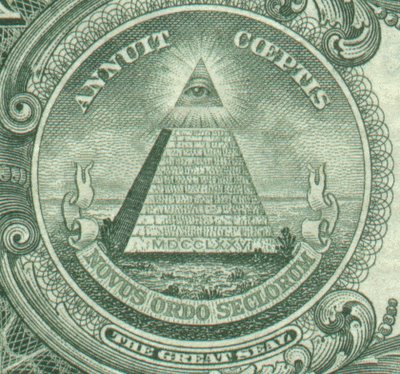
Novus Ordo Seclorum = New World Order.
A hundred years ago it was called “dollar diplomacy.” After World War II, and especially after the fall of the Soviet Union in 1989, that policy evolved into “dollar hegemony.” But after all these many years of great success, our dollar dominance is coming to an end.
It has been said, rightly, that he who holds the gold makes the rules. In earlier times it was readily accepted that fair and honest trade required an exchange for something of real value.
First it was simply barter of goods. Then it was discovered that gold held a universal attraction, and was a convenient substitute for more cumbersome barter transactions. Not only did gold facilitate exchange of goods and services, it served as a store of value for those who wanted to save for a rainy day.
Though money developed naturally in the marketplace, as governments grew in power they assumed monopoly control over money. Sometimes governments succeeded in guaranteeing the quality and purity of gold, but in time governments learned to outspend their revenues. New or higher taxes always incurred the disapproval of the people, so it wasn’t long before Kings and Caesars learned how to inflate their currencies by reducing the amount of gold in each coin-- always hoping their subjects wouldn’t discover the fraud. But the people always did, and they strenuously objected.
This helped pressure leaders to seek more gold by conquering other nations. The people became accustomed to living beyond their means, and enjoyed the circuses and bread. Financing extravagances by conquering foreign lands seemed a logical alternative to working harder and producing more. Besides, conquering nations not only brought home gold, they brought home slaves as well. Taxing the people in conquered territories also provided an incentive to build empires. This system of government worked well for a while, but the moral decline of the people led to an unwillingness to produce for themselves. There was a limit to the number of countries that could be sacked for their wealth, and this always brought empires to an end. When gold no longer could be obtained, their military might crumbled. In those days those who held the gold truly wrote the rules and lived well.
That general rule has held fast throughout the ages. When gold was used, and the rules protected honest commerce, productive nations thrived. Whenever wealthy nations-- those with powerful armies and gold-- strived only for empire and easy fortunes to support welfare at home, those nations failed.
Today the principles are the same, but the process is quite different. Gold no longer is the currency of the realm; paper is. The truth now is: “He who prints the money makes the rules”-- at least for the time being. Although gold is not used, the goals are the same: compel foreign countries to produce and subsidize the country with military superiority and control over the monetary printing presses.
Since printing paper money is nothing short of counterfeiting, the issuer of the international currency must always be the country with the military might to guarantee control over the system. This magnificent scheme seems the perfect system for obtaining perpetual wealth for the country that issues the de facto world currency. The one problem, however, is that such a system destroys the character of the counterfeiting nation’s people-- just as was the case when gold was the currency and it was obtained by conquering other nations. And this destroys the incentive to save and produce, while encouraging debt and runaway welfare.
The pressure at home to inflate the currency comes from the corporate welfare recipients, as well as those who demand handouts as compensation for their needs and perceived injuries by others. In both cases personal responsibility for one’s actions is rejected.
When paper money is rejected, or when gold runs out, wealth and political stability are lost. The country then must go from living beyond its means to living beneath its means, until the economic and political systems adjust to the new rules-- rules no longer written by those who ran the now defunct printing press.
“Dollar Diplomacy,” a policy instituted by William Howard Taft and his Secretary of State Philander C. Knox, was designed to enhance U.S. commercial investments in Latin America and the Far East. McKinley concocted a war against Spain in 1898, and (Teddy) Roosevelt’s corollary to the Monroe Doctrine preceded Taft’s aggressive approach to using the U.S. dollar and diplomatic influence to secure U.S. investments abroad. This earned the popular title of “Dollar Diplomacy.” The significance of Roosevelt’s change was that our intervention now could be justified by the mere “appearance” that a country of interest to us was politically or fiscally vulnerable to European control. Not only did we claim a right, but even an official U.S. government “obligation” to protect our commercial interests from Europeans.
This new policy came on the heels of the “gunboat” diplomacy of the late 19th century, and it meant we could buy influence before resorting to the threat of force. By the time the “dollar diplomacy” of William Howard Taft was clearly articulated, the seeds of American empire were planted. And they were destined to grow in the fertile political soil of a country that lost its love and respect for the republic bequeathed to us by the authors of the Constitution. And indeed they did. It wasn’t too long before dollar “diplomacy” became dollar “hegemony” in the second half of the 20th century.
This transition only could have occurred with a dramatic change in monetary policy and the nature of the dollar itself.
Congress created the Federal Reserve System in 1913. Between then and 1971 the principle of sound money was systematically undermined. Between 1913 and 1971, the Federal Reserve found it much easier to expand the money supply at will for financing war or manipulating the economy with little resistance from Congress-- while benefiting the special interests that influence government.
Dollar dominance got a huge boost after World War II. We were spared the destruction that so many other nations suffered, and our coffers were filled with the world’s gold. But the world chose not to return to the discipline of the gold standard, and the politicians applauded. Printing money to pay the bills was a lot more popular than taxing or restraining unnecessary spending. In spite of the short-term benefits, imbalances were institutionalized for decades to come.
The 1944 Bretton Woods agreement solidified the dollar as the preeminent world reserve currency, replacing the British pound. Due to our political and military muscle, and because we had a huge amount of physical gold, the world readily accepted our dollar (defined as 1/35th of an ounce of gold) as the world’s reserve currency. The dollar was said to be “as good as gold,” and convertible to all foreign central banks at that rate. For American citizens, however, it remained illegal to own. This was a gold-exchange standard that from inception was doomed to fail.
The U.S. did exactly what many predicted she would do. She printed more dollars for which there was no gold backing. But the world was content to accept those dollars for more than 25 years with little question-- until the French and others in the late 1960s demanded we fulfill our promise to pay one ounce of gold for each $35 they delivered to the U.S. Treasury. This resulted in a huge gold drain that brought an end to a very poorly devised pseudo-gold standard.
It all ended on August 15, 1971, when Nixon closed the gold window and refused to pay out any of our remaining 280 million ounces of gold. In essence, we declared our insolvency and everyone recognized some other monetary system had to be devised in order to bring stability to the markets.
Amazingly, a new system was devised which allowed the U.S. to operate the printing presses for the world reserve currency with no restraints placed on it-- not even a pretense of gold convertibility, none whatsoever! Though the new policy was even more deeply flawed, it nevertheless opened the door for dollar hegemony to spread.
Realizing the world was embarking on something new and mind boggling, elite money managers, with especially strong support from U.S. authorities, struck an agreement with OPEC to price oil in U.S. dollars exclusively for all worldwide transactions. This gave the dollar a special place among world currencies and in essence “backed” the dollar with oil. In return, the U.S. promised to protect the various oil-rich kingdoms in the Persian Gulf against threat of invasion or domestic coup. This arrangement helped ignite the radical Islamic movement among those who resented our influence in the region. The arrangement gave the dollar artificial strength, with tremendous financial benefits for the United States. It allowed us to export our monetary inflation by buying oil and other goods at a great discount as dollar influence flourished.
This post-Bretton Woods system was much more fragile than the system that existed between 1945 and 1971. Though the dollar/oil arrangement was helpful, it was not nearly as stable as the pseudo gold standard under Bretton Woods. It certainly was less stable than the gold standard of the late 19th century.
During the 1970s the dollar nearly collapsed, as oil prices surged and gold skyrocketed to $800 an ounce. By 1979 interest rates of 21% were required to rescue the system. The pressure on the dollar in the 1970s, in spite of the benefits accrued to it, reflected reckless budget deficits and monetary inflation during the 1960s. The markets were not fooled by LBJ’s claim that we could afford both “guns and butter.”
Once again the dollar was rescued, and this ushered in the age of true dollar hegemony lasting from the early 1980s to the present. With tremendous cooperation coming from the central banks and international commercial banks, the dollar was accepted as if it were gold.
Fed Chair Alan Greenspan, on several occasions before the House Banking Committee, answered my challenges to him about his previously held favorable views on gold by claiming that he and other central bankers had gotten paper money-- i.e. the dollar system-- to respond as if it were gold. Each time I strongly disagreed, and pointed out that if they had achieved such a feat they would have defied centuries of economic history regarding the need for money to be something of real value. He smugly and confidently concurred with this.
In recent years central banks and various financial institutions, all with vested interests in maintaining a workable fiat dollar standard, were not secretive about selling and loaning large amounts of gold to the market even while decreasing gold prices raised serious questions about the wisdom of such a policy. They never admitted to gold price fixing, but the evidence is abundant that they believed if the gold price fell it would convey a sense of confidence to the market, confidence that they indeed had achieved amazing success in turning paper into gold.
Increasing gold prices historically are viewed as an indicator of distrust in paper currency. This recent effort was not a whole lot different than the U.S. Treasury selling gold at $35 an ounce in the 1960s, in an attempt to convince the world the dollar was sound and as good as gold. Even during the Depression, one of Roosevelt’s first acts was to remove free market gold pricing as an indication of a flawed monetary system by making it illegal for American citizens to own gold. Economic law eventually limited that effort, as it did in the early 1970s when our Treasury and the IMF tried to fix the price of gold by dumping tons into the market to dampen the enthusiasm of those seeking a safe haven for a falling dollar after gold ownership was re-legalized.
Once again the effort between 1980 and 2000 to fool the market as to the true value of the dollar proved unsuccessful. In the past 5 years the dollar has been devalued in terms of gold by more than 50%. You just can’t fool all the people all the time, even with the power of the mighty printing press and money creating system of the Federal Reserve.
Even with all the shortcomings of the fiat monetary system, dollar influence thrived. The results seemed beneficial, but gross distortions built into the system remained. And true to form, Washington politicians are only too anxious to solve the problems cropping up with window dressing, while failing to understand and deal with the underlying flawed policy. Protectionism, fixing exchange rates, punitive tariffs, politically motivated sanctions, corporate subsidies, international trade management, price controls, interest rate and wage controls, super-nationalist sentiments, threats of force, and even war are resorted to—all to solve the problems artificially created by deeply flawed monetary and economic systems.
In the short run, the issuer of a fiat reserve currency can accrue great economic benefits. In the long run, it poses a threat to the country issuing the world currency. In this case that’s the United States. As long as foreign countries take our dollars in return for real goods, we come out ahead. This is a benefit many in Congress fail to recognize, as they bash China for maintaining a positive trade balance with us. But this leads to a loss of manufacturing jobs to overseas markets, as we become more dependent on others and less self-sufficient. Foreign countries accumulate our dollars due to their high savings rates, and graciously loan them back to us at low interest rates to finance our excessive consumption.
It sounds like a great deal for everyone, except the time will come when our dollars-- due to their depreciation-- will be received less enthusiastically or even be rejected by foreign countries. That could create a whole new ballgame and force us to pay a price for living beyond our means and our production. The shift in sentiment regarding the dollar has already started, but the worst is yet to come.
The agreement with OPEC in the 1970s to price oil in dollars has provided tremendous artificial strength to the dollar as the preeminent reserve currency. This has created a universal demand for the dollar, and soaks up the huge number of new dollars generated each year. Last year alone M3 increased over $700 billion.
The artificial demand for our dollar, along with our military might, places us in the unique position to “rule” the world without productive work or savings, and without limits on consumer spending or deficits. The problem is, it can’t last.
Price inflation is raising its ugly head, and the NASDAQ bubble-- generated by easy money-- has burst. The housing bubble likewise created is deflating. Gold prices have doubled, and federal spending is out of sight with zero political will to rein it in. The trade deficit last year was over $728 billion. A $2 trillion war is raging, and plans are being laid to expand the war into Iran and possibly Syria. The only restraining force will be the world’s rejection of the dollar. It’s bound to come and create conditions worse than 1979-1980, which required 21% interest rates to correct. But everything possible will be done to protect the dollar in the meantime. We have a shared interest with those who hold our dollars to keep the whole charade going.
Greenspan, in his first speech after leaving the Fed, said that gold prices were up because of concern about terrorism, and not because of monetary concerns or because he created too many dollars during his tenure. Gold has to be discredited and the dollar propped up. Even when the dollar comes under serious attack by market forces, the central banks and the IMF surely will do everything conceivable to soak up the dollars in hope of restoring stability. Eventually they will fail.
Most importantly, the dollar/oil relationship has to be maintained to keep the dollar as a preeminent currency. Any attack on this relationship will be forcefully challenged—as it already has been.
In November 2000 Saddam Hussein demanded Euros for his oil. His arrogance was a threat to the dollar; his lack of any military might was never a threat. At the first cabinet meeting with the new administration in 2001, as reported by Treasury Secretary Paul O’Neill, the major topic was how we would get rid of Saddam Hussein-- though there was no evidence whatsoever he posed a threat to us. This deep concern for Saddam Hussein surprised and shocked O’Neill.
It now is common knowledge that the immediate reaction of the administration after 9/11 revolved around how they could connect Saddam Hussein to the attacks, to justify an invasion and overthrow of his government. Even with no evidence of any connection to 9/11, or evidence of weapons of mass destruction, public and congressional support was generated through distortions and flat out misrepresentation of the facts to justify overthrowing Saddam Hussein.
There was no public talk of removing Saddam Hussein because of his attack on the integrity of the dollar as a reserve currency by selling oil in Euros. Many believe this was the real reason for our obsession with Iraq. I doubt it was the only reason, but it may well have played a significant role in our motivation to wage war. Within a very short period after the military victory, all Iraqi oil sales were carried out in dollars. The Euro was abandoned.
In 2001, Venezuela’s ambassador to Russia spoke of Venezuela switching to the Euro for all their oil sales. Within a year there was a coup attempt against Chavez, reportedly with assistance from our CIA.
After these attempts to nudge the Euro toward replacing the dollar as the world’s reserve currency were met with resistance, the sharp fall of the dollar against the Euro was reversed. These events may well have played a significant role in maintaining dollar dominance.
It’s become clear the U.S. administration was sympathetic to those who plotted the overthrow of Chavez, and was embarrassed by its failure. The fact that Chavez was democratically elected had little influence on which side we supported.
Now, a new attempt is being made against the petrodollar system. Iran, another member of the “axis of evil,” has announced her plans to initiate an oil bourse in March of this year. Guess what, the oil sales will be priced Euros, not dollars.
Most Americans forget how our policies have systematically and needlessly antagonized the Iranians over the years. In 1953 the CIA helped overthrow a democratically elected president, Mohammed Mossadeqh, and install the authoritarian Shah, who was friendly to the U.S. The Iranians were still fuming over this when the hostages were seized in 1979. Our alliance with Saddam Hussein in his invasion of Iran in the early 1980s did not help matters, and obviously did not do much for our relationship with Saddam Hussein. The administration announcement in 2001 that Iran was part of the axis of evil didn’t do much to improve the diplomatic relationship between our two countries. Recent threats over nuclear power, while ignoring the fact that they are surrounded by countries with nuclear weapons, doesn’t seem to register with those who continue to provoke Iran. With what most Muslims perceive as our war against Islam, and this recent history, there’s little wonder why Iran might choose to harm America by undermining the dollar. Iran, like Iraq, has zero capability to attack us. But that didn’t stop us from turning Saddam Hussein into a modern day Hitler ready to take over the world. Now Iran, especially since she’s made plans for pricing oil in Euros, has been on the receiving end of a propaganda war not unlike that waged against Iraq before our invasion.
It’s not likely that maintaining dollar supremacy was the only motivating factor for the war against Iraq, nor for agitating against Iran. Though the real reasons for going to war are complex, we now know the reasons given before the war started, like the presence of weapons of mass destruction and Saddam Hussein’s connection to 9/11, were false. The dollar’s importance is obvious, but this does not diminish the influence of the distinct plans laid out years ago by the neo-conservatives to remake the Middle East. Israel’s influence, as well as that of the Christian Zionists, likewise played a role in prosecuting this war. Protecting “our” oil supplies has influenced our Middle East policy for decades.
But the truth is that paying the bills for this aggressive intervention is impossible the old fashioned way, with more taxes, more savings, and more production by the American people. Much of the expense of the Persian Gulf War in 1991 was shouldered by many of our willing allies. That’s not so today. Now, more than ever, the dollar hegemony-- it’s dominance as the world reserve currency-- is required to finance our huge war expenditures. This $2 trillion never-ending war must be paid for, one way or another. Dollar hegemony provides the vehicle to do just that.
For the most part the true victims aren’t aware of how they pay the bills. The license to create money out of thin air allows the bills to be paid through price inflation. American citizens, as well as average citizens of Japan, China, and other countries suffer from price inflation, which represents the “tax” that pays the bills for our military adventures. That is until the fraud is discovered, and the foreign producers decide not to take dollars nor hold them very long in payment for their goods. Everything possible is done to prevent the fraud of the monetary system from being exposed to the masses who suffer from it. If oil markets replace dollars with Euros, it would in time curtail our ability to continue to print, without restraint, the world’s reserve currency.
It is an unbelievable benefit to us to import valuable goods and export depreciating dollars. The exporting countries have become addicted to our purchases for their economic growth. This dependency makes them allies in continuing the fraud, and their participation keeps the dollar’s value artificially high. If this system were workable long term, American citizens would never have to work again. We too could enjoy “bread and circuses” just as the Romans did, but their gold finally ran out and the inability of Rome to continue to plunder conquered nations brought an end to her empire.
The same thing will happen to us if we don’t change our ways. Though we don’t occupy foreign countries to directly plunder, we nevertheless have spread our troops across 130 nations of the world. Our intense effort to spread our power in the oil-rich Middle East is not a coincidence. But unlike the old days, we don’t declare direct ownership of the natural resources-- we just insist that we can buy what we want and pay for it with our paper money. Any country that challenges our authority does so at great risk.
Once again Congress has bought into the war propaganda against Iran, just as it did against Iraq. Arguments are now made for attacking Iran economically, and militarily if necessary. These arguments are all based on the same false reasons given for the ill-fated and costly occupation of Iraq.
Our whole economic system depends on continuing the current monetary arrangement, which means recycling the dollar is crucial. Currently, we borrow over $700 billion every year from our gracious benefactors, who work hard and take our paper for their goods. Then we borrow all the money we need to secure the empire (DOD budget $450 billion) plus more. The military might we enjoy becomes the “backing” of our currency. There are no other countries that can challenge our military superiority, and therefore they have little choice but to accept the dollars we declare are today’s “gold.” This is why countries that challenge the system-- like Iraq, Iran and Venezuela-- become targets of our plans for regime change.
Ironically, dollar superiority depends on our strong military, and our strong military depends on the dollar. As long as foreign recipients take our dollars for real goods and are willing to finance our extravagant consumption and militarism, the status quo will continue regardless of how huge our foreign debt and current account deficit become.
But real threats come from our political adversaries who are incapable of confronting us militarily, yet are not bashful about confronting us economically. That’s why we see the new challenge from Iran being taken so seriously. The urgent arguments about Iran posing a military threat to the security of the United States are no more plausible than the false charges levied against Iraq. Yet there is no effort to resist this march to confrontation by those who grandstand for political reasons against the Iraq war.
It seems that the people and Congress are easily persuaded by the jingoism of the preemptive war promoters. It’s only after the cost in human life and dollars are tallied up that the people object to unwise militarism.
The strange thing is that the failure in Iraq is now apparent to a large majority of American people, yet they and Congress are acquiescing to the call for a needless and dangerous confrontation with Iran.
But then again, our failure to find Osama bin Laden and destroy his network did not dissuade us from taking on the Iraqis in a war totally unrelated to 9/11.
Concern for pricing oil only in dollars helps explain our willingness to drop everything and teach Saddam Hussein a lesson for his defiance in demanding Euros for oil.
And once again there’s this urgent call for sanctions and threats of force against Iran at the precise time Iran is opening a new oil exchange with all transactions in Euros.
Using force to compel people to accept money without real value can only work in the short run. It ultimately leads to economic dislocation, both domestic and international, and always ends with a price to be paid.
The economic law that honest exchange demands only things of real value as currency cannot be repealed. The chaos that one day will ensue from our 35-year experiment with worldwide fiat money will require a return to money of real value. We will know that day is approaching when oil-producing countries demand gold, or its equivalent, for their oil rather than dollars or Euros. The sooner the better.
HON. RON PAUL OF TEXAS
Before the U.S. House of Representatives
February 15, 2006

Novus Ordo Seclorum = New World Order.
A hundred years ago it was called “dollar diplomacy.” After World War II, and especially after the fall of the Soviet Union in 1989, that policy evolved into “dollar hegemony.” But after all these many years of great success, our dollar dominance is coming to an end.
It has been said, rightly, that he who holds the gold makes the rules. In earlier times it was readily accepted that fair and honest trade required an exchange for something of real value.
First it was simply barter of goods. Then it was discovered that gold held a universal attraction, and was a convenient substitute for more cumbersome barter transactions. Not only did gold facilitate exchange of goods and services, it served as a store of value for those who wanted to save for a rainy day.
Though money developed naturally in the marketplace, as governments grew in power they assumed monopoly control over money. Sometimes governments succeeded in guaranteeing the quality and purity of gold, but in time governments learned to outspend their revenues. New or higher taxes always incurred the disapproval of the people, so it wasn’t long before Kings and Caesars learned how to inflate their currencies by reducing the amount of gold in each coin-- always hoping their subjects wouldn’t discover the fraud. But the people always did, and they strenuously objected.
This helped pressure leaders to seek more gold by conquering other nations. The people became accustomed to living beyond their means, and enjoyed the circuses and bread. Financing extravagances by conquering foreign lands seemed a logical alternative to working harder and producing more. Besides, conquering nations not only brought home gold, they brought home slaves as well. Taxing the people in conquered territories also provided an incentive to build empires. This system of government worked well for a while, but the moral decline of the people led to an unwillingness to produce for themselves. There was a limit to the number of countries that could be sacked for their wealth, and this always brought empires to an end. When gold no longer could be obtained, their military might crumbled. In those days those who held the gold truly wrote the rules and lived well.
That general rule has held fast throughout the ages. When gold was used, and the rules protected honest commerce, productive nations thrived. Whenever wealthy nations-- those with powerful armies and gold-- strived only for empire and easy fortunes to support welfare at home, those nations failed.
Today the principles are the same, but the process is quite different. Gold no longer is the currency of the realm; paper is. The truth now is: “He who prints the money makes the rules”-- at least for the time being. Although gold is not used, the goals are the same: compel foreign countries to produce and subsidize the country with military superiority and control over the monetary printing presses.
Since printing paper money is nothing short of counterfeiting, the issuer of the international currency must always be the country with the military might to guarantee control over the system. This magnificent scheme seems the perfect system for obtaining perpetual wealth for the country that issues the de facto world currency. The one problem, however, is that such a system destroys the character of the counterfeiting nation’s people-- just as was the case when gold was the currency and it was obtained by conquering other nations. And this destroys the incentive to save and produce, while encouraging debt and runaway welfare.
The pressure at home to inflate the currency comes from the corporate welfare recipients, as well as those who demand handouts as compensation for their needs and perceived injuries by others. In both cases personal responsibility for one’s actions is rejected.
When paper money is rejected, or when gold runs out, wealth and political stability are lost. The country then must go from living beyond its means to living beneath its means, until the economic and political systems adjust to the new rules-- rules no longer written by those who ran the now defunct printing press.
“Dollar Diplomacy,” a policy instituted by William Howard Taft and his Secretary of State Philander C. Knox, was designed to enhance U.S. commercial investments in Latin America and the Far East. McKinley concocted a war against Spain in 1898, and (Teddy) Roosevelt’s corollary to the Monroe Doctrine preceded Taft’s aggressive approach to using the U.S. dollar and diplomatic influence to secure U.S. investments abroad. This earned the popular title of “Dollar Diplomacy.” The significance of Roosevelt’s change was that our intervention now could be justified by the mere “appearance” that a country of interest to us was politically or fiscally vulnerable to European control. Not only did we claim a right, but even an official U.S. government “obligation” to protect our commercial interests from Europeans.
This new policy came on the heels of the “gunboat” diplomacy of the late 19th century, and it meant we could buy influence before resorting to the threat of force. By the time the “dollar diplomacy” of William Howard Taft was clearly articulated, the seeds of American empire were planted. And they were destined to grow in the fertile political soil of a country that lost its love and respect for the republic bequeathed to us by the authors of the Constitution. And indeed they did. It wasn’t too long before dollar “diplomacy” became dollar “hegemony” in the second half of the 20th century.
This transition only could have occurred with a dramatic change in monetary policy and the nature of the dollar itself.
Congress created the Federal Reserve System in 1913. Between then and 1971 the principle of sound money was systematically undermined. Between 1913 and 1971, the Federal Reserve found it much easier to expand the money supply at will for financing war or manipulating the economy with little resistance from Congress-- while benefiting the special interests that influence government.
Dollar dominance got a huge boost after World War II. We were spared the destruction that so many other nations suffered, and our coffers were filled with the world’s gold. But the world chose not to return to the discipline of the gold standard, and the politicians applauded. Printing money to pay the bills was a lot more popular than taxing or restraining unnecessary spending. In spite of the short-term benefits, imbalances were institutionalized for decades to come.
The 1944 Bretton Woods agreement solidified the dollar as the preeminent world reserve currency, replacing the British pound. Due to our political and military muscle, and because we had a huge amount of physical gold, the world readily accepted our dollar (defined as 1/35th of an ounce of gold) as the world’s reserve currency. The dollar was said to be “as good as gold,” and convertible to all foreign central banks at that rate. For American citizens, however, it remained illegal to own. This was a gold-exchange standard that from inception was doomed to fail.
The U.S. did exactly what many predicted she would do. She printed more dollars for which there was no gold backing. But the world was content to accept those dollars for more than 25 years with little question-- until the French and others in the late 1960s demanded we fulfill our promise to pay one ounce of gold for each $35 they delivered to the U.S. Treasury. This resulted in a huge gold drain that brought an end to a very poorly devised pseudo-gold standard.
It all ended on August 15, 1971, when Nixon closed the gold window and refused to pay out any of our remaining 280 million ounces of gold. In essence, we declared our insolvency and everyone recognized some other monetary system had to be devised in order to bring stability to the markets.
Amazingly, a new system was devised which allowed the U.S. to operate the printing presses for the world reserve currency with no restraints placed on it-- not even a pretense of gold convertibility, none whatsoever! Though the new policy was even more deeply flawed, it nevertheless opened the door for dollar hegemony to spread.
Realizing the world was embarking on something new and mind boggling, elite money managers, with especially strong support from U.S. authorities, struck an agreement with OPEC to price oil in U.S. dollars exclusively for all worldwide transactions. This gave the dollar a special place among world currencies and in essence “backed” the dollar with oil. In return, the U.S. promised to protect the various oil-rich kingdoms in the Persian Gulf against threat of invasion or domestic coup. This arrangement helped ignite the radical Islamic movement among those who resented our influence in the region. The arrangement gave the dollar artificial strength, with tremendous financial benefits for the United States. It allowed us to export our monetary inflation by buying oil and other goods at a great discount as dollar influence flourished.
This post-Bretton Woods system was much more fragile than the system that existed between 1945 and 1971. Though the dollar/oil arrangement was helpful, it was not nearly as stable as the pseudo gold standard under Bretton Woods. It certainly was less stable than the gold standard of the late 19th century.
During the 1970s the dollar nearly collapsed, as oil prices surged and gold skyrocketed to $800 an ounce. By 1979 interest rates of 21% were required to rescue the system. The pressure on the dollar in the 1970s, in spite of the benefits accrued to it, reflected reckless budget deficits and monetary inflation during the 1960s. The markets were not fooled by LBJ’s claim that we could afford both “guns and butter.”
Once again the dollar was rescued, and this ushered in the age of true dollar hegemony lasting from the early 1980s to the present. With tremendous cooperation coming from the central banks and international commercial banks, the dollar was accepted as if it were gold.
Fed Chair Alan Greenspan, on several occasions before the House Banking Committee, answered my challenges to him about his previously held favorable views on gold by claiming that he and other central bankers had gotten paper money-- i.e. the dollar system-- to respond as if it were gold. Each time I strongly disagreed, and pointed out that if they had achieved such a feat they would have defied centuries of economic history regarding the need for money to be something of real value. He smugly and confidently concurred with this.
In recent years central banks and various financial institutions, all with vested interests in maintaining a workable fiat dollar standard, were not secretive about selling and loaning large amounts of gold to the market even while decreasing gold prices raised serious questions about the wisdom of such a policy. They never admitted to gold price fixing, but the evidence is abundant that they believed if the gold price fell it would convey a sense of confidence to the market, confidence that they indeed had achieved amazing success in turning paper into gold.
Increasing gold prices historically are viewed as an indicator of distrust in paper currency. This recent effort was not a whole lot different than the U.S. Treasury selling gold at $35 an ounce in the 1960s, in an attempt to convince the world the dollar was sound and as good as gold. Even during the Depression, one of Roosevelt’s first acts was to remove free market gold pricing as an indication of a flawed monetary system by making it illegal for American citizens to own gold. Economic law eventually limited that effort, as it did in the early 1970s when our Treasury and the IMF tried to fix the price of gold by dumping tons into the market to dampen the enthusiasm of those seeking a safe haven for a falling dollar after gold ownership was re-legalized.
Once again the effort between 1980 and 2000 to fool the market as to the true value of the dollar proved unsuccessful. In the past 5 years the dollar has been devalued in terms of gold by more than 50%. You just can’t fool all the people all the time, even with the power of the mighty printing press and money creating system of the Federal Reserve.
Even with all the shortcomings of the fiat monetary system, dollar influence thrived. The results seemed beneficial, but gross distortions built into the system remained. And true to form, Washington politicians are only too anxious to solve the problems cropping up with window dressing, while failing to understand and deal with the underlying flawed policy. Protectionism, fixing exchange rates, punitive tariffs, politically motivated sanctions, corporate subsidies, international trade management, price controls, interest rate and wage controls, super-nationalist sentiments, threats of force, and even war are resorted to—all to solve the problems artificially created by deeply flawed monetary and economic systems.
In the short run, the issuer of a fiat reserve currency can accrue great economic benefits. In the long run, it poses a threat to the country issuing the world currency. In this case that’s the United States. As long as foreign countries take our dollars in return for real goods, we come out ahead. This is a benefit many in Congress fail to recognize, as they bash China for maintaining a positive trade balance with us. But this leads to a loss of manufacturing jobs to overseas markets, as we become more dependent on others and less self-sufficient. Foreign countries accumulate our dollars due to their high savings rates, and graciously loan them back to us at low interest rates to finance our excessive consumption.
It sounds like a great deal for everyone, except the time will come when our dollars-- due to their depreciation-- will be received less enthusiastically or even be rejected by foreign countries. That could create a whole new ballgame and force us to pay a price for living beyond our means and our production. The shift in sentiment regarding the dollar has already started, but the worst is yet to come.
The agreement with OPEC in the 1970s to price oil in dollars has provided tremendous artificial strength to the dollar as the preeminent reserve currency. This has created a universal demand for the dollar, and soaks up the huge number of new dollars generated each year. Last year alone M3 increased over $700 billion.
The artificial demand for our dollar, along with our military might, places us in the unique position to “rule” the world without productive work or savings, and without limits on consumer spending or deficits. The problem is, it can’t last.
Price inflation is raising its ugly head, and the NASDAQ bubble-- generated by easy money-- has burst. The housing bubble likewise created is deflating. Gold prices have doubled, and federal spending is out of sight with zero political will to rein it in. The trade deficit last year was over $728 billion. A $2 trillion war is raging, and plans are being laid to expand the war into Iran and possibly Syria. The only restraining force will be the world’s rejection of the dollar. It’s bound to come and create conditions worse than 1979-1980, which required 21% interest rates to correct. But everything possible will be done to protect the dollar in the meantime. We have a shared interest with those who hold our dollars to keep the whole charade going.
Greenspan, in his first speech after leaving the Fed, said that gold prices were up because of concern about terrorism, and not because of monetary concerns or because he created too many dollars during his tenure. Gold has to be discredited and the dollar propped up. Even when the dollar comes under serious attack by market forces, the central banks and the IMF surely will do everything conceivable to soak up the dollars in hope of restoring stability. Eventually they will fail.
Most importantly, the dollar/oil relationship has to be maintained to keep the dollar as a preeminent currency. Any attack on this relationship will be forcefully challenged—as it already has been.
In November 2000 Saddam Hussein demanded Euros for his oil. His arrogance was a threat to the dollar; his lack of any military might was never a threat. At the first cabinet meeting with the new administration in 2001, as reported by Treasury Secretary Paul O’Neill, the major topic was how we would get rid of Saddam Hussein-- though there was no evidence whatsoever he posed a threat to us. This deep concern for Saddam Hussein surprised and shocked O’Neill.
It now is common knowledge that the immediate reaction of the administration after 9/11 revolved around how they could connect Saddam Hussein to the attacks, to justify an invasion and overthrow of his government. Even with no evidence of any connection to 9/11, or evidence of weapons of mass destruction, public and congressional support was generated through distortions and flat out misrepresentation of the facts to justify overthrowing Saddam Hussein.
There was no public talk of removing Saddam Hussein because of his attack on the integrity of the dollar as a reserve currency by selling oil in Euros. Many believe this was the real reason for our obsession with Iraq. I doubt it was the only reason, but it may well have played a significant role in our motivation to wage war. Within a very short period after the military victory, all Iraqi oil sales were carried out in dollars. The Euro was abandoned.
In 2001, Venezuela’s ambassador to Russia spoke of Venezuela switching to the Euro for all their oil sales. Within a year there was a coup attempt against Chavez, reportedly with assistance from our CIA.
After these attempts to nudge the Euro toward replacing the dollar as the world’s reserve currency were met with resistance, the sharp fall of the dollar against the Euro was reversed. These events may well have played a significant role in maintaining dollar dominance.
It’s become clear the U.S. administration was sympathetic to those who plotted the overthrow of Chavez, and was embarrassed by its failure. The fact that Chavez was democratically elected had little influence on which side we supported.
Now, a new attempt is being made against the petrodollar system. Iran, another member of the “axis of evil,” has announced her plans to initiate an oil bourse in March of this year. Guess what, the oil sales will be priced Euros, not dollars.
Most Americans forget how our policies have systematically and needlessly antagonized the Iranians over the years. In 1953 the CIA helped overthrow a democratically elected president, Mohammed Mossadeqh, and install the authoritarian Shah, who was friendly to the U.S. The Iranians were still fuming over this when the hostages were seized in 1979. Our alliance with Saddam Hussein in his invasion of Iran in the early 1980s did not help matters, and obviously did not do much for our relationship with Saddam Hussein. The administration announcement in 2001 that Iran was part of the axis of evil didn’t do much to improve the diplomatic relationship between our two countries. Recent threats over nuclear power, while ignoring the fact that they are surrounded by countries with nuclear weapons, doesn’t seem to register with those who continue to provoke Iran. With what most Muslims perceive as our war against Islam, and this recent history, there’s little wonder why Iran might choose to harm America by undermining the dollar. Iran, like Iraq, has zero capability to attack us. But that didn’t stop us from turning Saddam Hussein into a modern day Hitler ready to take over the world. Now Iran, especially since she’s made plans for pricing oil in Euros, has been on the receiving end of a propaganda war not unlike that waged against Iraq before our invasion.
It’s not likely that maintaining dollar supremacy was the only motivating factor for the war against Iraq, nor for agitating against Iran. Though the real reasons for going to war are complex, we now know the reasons given before the war started, like the presence of weapons of mass destruction and Saddam Hussein’s connection to 9/11, were false. The dollar’s importance is obvious, but this does not diminish the influence of the distinct plans laid out years ago by the neo-conservatives to remake the Middle East. Israel’s influence, as well as that of the Christian Zionists, likewise played a role in prosecuting this war. Protecting “our” oil supplies has influenced our Middle East policy for decades.
But the truth is that paying the bills for this aggressive intervention is impossible the old fashioned way, with more taxes, more savings, and more production by the American people. Much of the expense of the Persian Gulf War in 1991 was shouldered by many of our willing allies. That’s not so today. Now, more than ever, the dollar hegemony-- it’s dominance as the world reserve currency-- is required to finance our huge war expenditures. This $2 trillion never-ending war must be paid for, one way or another. Dollar hegemony provides the vehicle to do just that.
For the most part the true victims aren’t aware of how they pay the bills. The license to create money out of thin air allows the bills to be paid through price inflation. American citizens, as well as average citizens of Japan, China, and other countries suffer from price inflation, which represents the “tax” that pays the bills for our military adventures. That is until the fraud is discovered, and the foreign producers decide not to take dollars nor hold them very long in payment for their goods. Everything possible is done to prevent the fraud of the monetary system from being exposed to the masses who suffer from it. If oil markets replace dollars with Euros, it would in time curtail our ability to continue to print, without restraint, the world’s reserve currency.
It is an unbelievable benefit to us to import valuable goods and export depreciating dollars. The exporting countries have become addicted to our purchases for their economic growth. This dependency makes them allies in continuing the fraud, and their participation keeps the dollar’s value artificially high. If this system were workable long term, American citizens would never have to work again. We too could enjoy “bread and circuses” just as the Romans did, but their gold finally ran out and the inability of Rome to continue to plunder conquered nations brought an end to her empire.
The same thing will happen to us if we don’t change our ways. Though we don’t occupy foreign countries to directly plunder, we nevertheless have spread our troops across 130 nations of the world. Our intense effort to spread our power in the oil-rich Middle East is not a coincidence. But unlike the old days, we don’t declare direct ownership of the natural resources-- we just insist that we can buy what we want and pay for it with our paper money. Any country that challenges our authority does so at great risk.
Once again Congress has bought into the war propaganda against Iran, just as it did against Iraq. Arguments are now made for attacking Iran economically, and militarily if necessary. These arguments are all based on the same false reasons given for the ill-fated and costly occupation of Iraq.
Our whole economic system depends on continuing the current monetary arrangement, which means recycling the dollar is crucial. Currently, we borrow over $700 billion every year from our gracious benefactors, who work hard and take our paper for their goods. Then we borrow all the money we need to secure the empire (DOD budget $450 billion) plus more. The military might we enjoy becomes the “backing” of our currency. There are no other countries that can challenge our military superiority, and therefore they have little choice but to accept the dollars we declare are today’s “gold.” This is why countries that challenge the system-- like Iraq, Iran and Venezuela-- become targets of our plans for regime change.
Ironically, dollar superiority depends on our strong military, and our strong military depends on the dollar. As long as foreign recipients take our dollars for real goods and are willing to finance our extravagant consumption and militarism, the status quo will continue regardless of how huge our foreign debt and current account deficit become.
But real threats come from our political adversaries who are incapable of confronting us militarily, yet are not bashful about confronting us economically. That’s why we see the new challenge from Iran being taken so seriously. The urgent arguments about Iran posing a military threat to the security of the United States are no more plausible than the false charges levied against Iraq. Yet there is no effort to resist this march to confrontation by those who grandstand for political reasons against the Iraq war.
It seems that the people and Congress are easily persuaded by the jingoism of the preemptive war promoters. It’s only after the cost in human life and dollars are tallied up that the people object to unwise militarism.
The strange thing is that the failure in Iraq is now apparent to a large majority of American people, yet they and Congress are acquiescing to the call for a needless and dangerous confrontation with Iran.
But then again, our failure to find Osama bin Laden and destroy his network did not dissuade us from taking on the Iraqis in a war totally unrelated to 9/11.
Concern for pricing oil only in dollars helps explain our willingness to drop everything and teach Saddam Hussein a lesson for his defiance in demanding Euros for oil.
And once again there’s this urgent call for sanctions and threats of force against Iran at the precise time Iran is opening a new oil exchange with all transactions in Euros.
Using force to compel people to accept money without real value can only work in the short run. It ultimately leads to economic dislocation, both domestic and international, and always ends with a price to be paid.
The economic law that honest exchange demands only things of real value as currency cannot be repealed. The chaos that one day will ensue from our 35-year experiment with worldwide fiat money will require a return to money of real value. We will know that day is approaching when oil-producing countries demand gold, or its equivalent, for their oil rather than dollars or Euros. The sooner the better.
Jimmy Carter reveals Stargate via: WayneMadsenReport.com
February 26, 2006 -- President Jimmy Carter, in an interview with GQ, revealed the existence of a onetime top secret operation involving "remote viewing," the use of psychics in para-psychological espionage directed against the USSR. The Soviets also maintained a similar program during the Cold War.
"GQ: One of the promises you made in 1976 was that if you were elected, you would look into the reports from Roswell and see if there had been any cover-ups. Did you look into that?
Carter: Well, in a way. I became more aware of what our intelligence services were doing. There was only one instance that I’ll talk about now. We had a plane go down in the Central African Republic—a twin-engine plane, small plane. And we couldn’t find it. And so we oriented satellites that were going around the earth every ninety minutes to fly over that spot where we thought it might be and take photographs. We couldn’t find it. So the director of the CIA came and told me that he had contacted a woman in California that claimed to have supernatural capabilities. And she went in a trance, and she wrote down latitudes and longitudes, and we sent our satellite over that latitude and longitude, and there was the plane.
GQ: That must have been surreal for you. You’re the president of the United States, and you’re getting intelligence information from a woman in a trance in California.
Carter: That’s exactly right.
GQ: How did your scientific mind process that?
Carter: With skepticism. Whether it was just a gross coincidence or…I don’t know. But that’s one thing that I couldn’t explain."
The CIA's remote viewing was known by various cover names, including Stargate. The Defense Intelligence Agency (DIA) also maintained a remote viewing program code named Sun Streak. The prototype CIA remote viewing program, run by Stanford Research Institute (SRI), was code named Project Scanate. Other CIA cover names for remote viewing included Centre Lane, Gondola Wish, and Grill Flame.

Carter: confirms CIA remote viewing project.
A former high-ranking official of Carter's National Security Council and officer in Naval Intelligence confirmed the existence of the CIA's remote viewing program and the use of para-psychics to locate secret Soviet missile bases and ballistic missile submarines. However, he conceded that both the U.S. and Soviet remote viewing programs were plagued with problems, including constant interference from "third parties."
After Stargate's exposure by ABC's Nightline in 1995, it was reportedly defunded. However, according to NSA sources, remote viewing remains an ultra secret project at the signals intelligence agency. According to those familiar with the program, the protocols followed have actually complied with U.S. Signals Intelligence Directive 18 (USSID 18), which implements the Foreign Intelligence Surveillance Act (FISA). U.S. persons have been protected by the use of mandatory "two person control" (a viewer and a special handler) during remote viewing sessions, carried out in a super secure chamber at NSA Headquarters in Fort Meade, Maryland. With recent disclosures about NSA's violations of FISA by order of the Bush White House, there are concerns that NSA's remote viewing program no longer complies with FISA or USSID 18.
Friday, February 24, 2006
Elijah Muhammed & Crowley
"Of all the knowledge that one may have or obtain, the knowledge of God is the greatest and the most necessary of all knowledge."
-Honorable Elijah Muhammed
"Not all the filth of London can keep me from the Light of God, and by that Light, I live."
- A. Crowley
-Honorable Elijah Muhammed
"Not all the filth of London can keep me from the Light of God, and by that Light, I live."
- A. Crowley
Sunday, February 19, 2006


Tuesday, February 14, 2006
okcupid
Link: The 32-Type Dating Test by OkCupid - Free Online Dating. My profile name: ottovonbone |

Monday, February 13, 2006
U.S. concludes 'Cyber Storm' mock attacks
Friday, February 10, 2006 ·
U.S. concludes 'Cyber Storm' mock attacks
WASHINGTON -- The government concluded its "Cyber Storm" wargame Friday, its biggest-ever exercise to test how it would respond to devastating attacks over the Internet from anti-globalization activists, underground hackers and bloggers.
Bloggers?
Participants confirmed parts of the worldwide simulation challenged government officials and industry executives to respond to deliberate misinformation campaigns and activist calls by Internet bloggers, online diarists whose "Web logs" include political rantings and musings about current events.
The Internet survived, even against fictional abuses against the world's computers on a scale typical for Fox's popular "24" television series. Experts depicted hackers who shut down electricity in 10 states, failures in vital systems for online banking and retail sales, infected discs mistakenly distributed by commercial software companies and critical flaws discovered in core Internet technology.
Some mock attacks were aimed at causing a "significant cyber disruption" that could seriously damage energy, transportation and health care industries and undermine public confidence, said George Foresman, an undersecretary at the Homeland Security Department.
There was no impact on the real Internet during the weeklong exercise. Government officials from the United States, Canada, Australia and England and executives from Microsoft, Cisco, Verisign and others said they were careful to simulate attacks only using isolated computers, working from basement offices at the Secret Services headquarters in downtown Washington.
The Homeland Security Department promised a full report on results from the exercise by summer.
Foresman likened his agency's role during any Internet attack to an orchestra conductor, coordinating responses from law enforcement, intelligence agencies, the military and private firms. The government's goal is a "symphony of preparedness," Foresman said.
Homeland Security coordinated the exercise. More than 115 government agencies, companies and organizations participated. They included the White House National Security Council, Justice Department, Defense Department, State Department, National Security Agency and CIA, which conducted its own cybersecurity exercise called "Silent Horizon" last May.
An earlier cyberterrorism exercise called "Livewire" for Homeland Security and other federal agencies concluded there were serious questions over government's role during a cyberattack depending on who was identified as the culprit - terrorists, a foreign government or bored teenagers.
It also questioned whether the U.S. government would be able to detect the early stages of such an attack without significant help from private technology companies.
Friday, February 10, 2006
Gold & Inflation
"In the absence of the gold standard, there is no way to protect savings from confiscation through inflation. There is no safe store of value ... The financial policy of the welfare state requires that there be no way for the owners of wealth to protect themselves. This is the shabby secret of the welfare statists' tirades against gold. Deficit spending is simply a scheme for the confiscation of wealth."
--– Alan Greenspan, "Gold and Economic Freedom," 1967
“Remember that inflation is only the act of printing money in excess of Gross National Product. They could blame it on the price of widgets or oil only because you never knew the real cause. The real cause and only cause of inflation is the printing of more money beyond the Gross National Product.
They must eventually resort to war to balance the account, because war ultimately is merely the act of destroying the creditor, and the politicians are the publicly hired hit men that justify the act to keep the responsibility and blood off the public conscience.”
--- William Cooper, Behold A Pale Horse pg. 49
Thursday, January 12, 2006


Subscribe to:
Posts (Atom)